At the end of the play, as the lights go out, as the curtains close, as bottles of champagne gleam in the wings waiting to be popped, Sir Castle presses her forehead to mine and says, “Look for me later, before I become something that isn’t real.”
No one else hears her over the roar of the audience, and in the confusion of the celebration, I lose sight of her. I look to my right during curtain call and in Sir Castle’s place stands her understudy, Sophie, who takes my hand and dips me into a bow.
The problem is, of course, I don’t know Sir Castle’s real name, and by the time I remember that I’m supposed to look for her, I’ve had three glasses of champagne and Sophie’s sitting in my lap, her lipstick on my ear.
“A lot of us don’t give our real names, sweetheart,” she reminds me, when I ask her if she knows who Sir Castle is. “Not when there’s a good chance they’ll be printed in the newspaper, and not in Arts & Culture either.”
“That hasn’t happened in a while,” I say, too drunk. My name isn’t on the playbill, but plenty of people here know what to call me.
“That’s because we’re protected,” Sophie says, pronouncing this with enough ceremony to inform me that she’s drunk too. “And to find Sir Castle, you’ll have to take those protections with you.”
Sophie leads me upstairs, past the director’s office, past the lights closets and dark corners where cast and crew have their hands inside each other’s clothes. Tomorrow, the play may end, the theater’s windows smashed in, all copies of the script incinerated. But tonight, we were loud and alive, and the audience stood on its feet to howl its approval.
“If you can find her,” Sophie warns, “others will too.”
“She asked me,” I say. “My knight, my lover, asked me.”
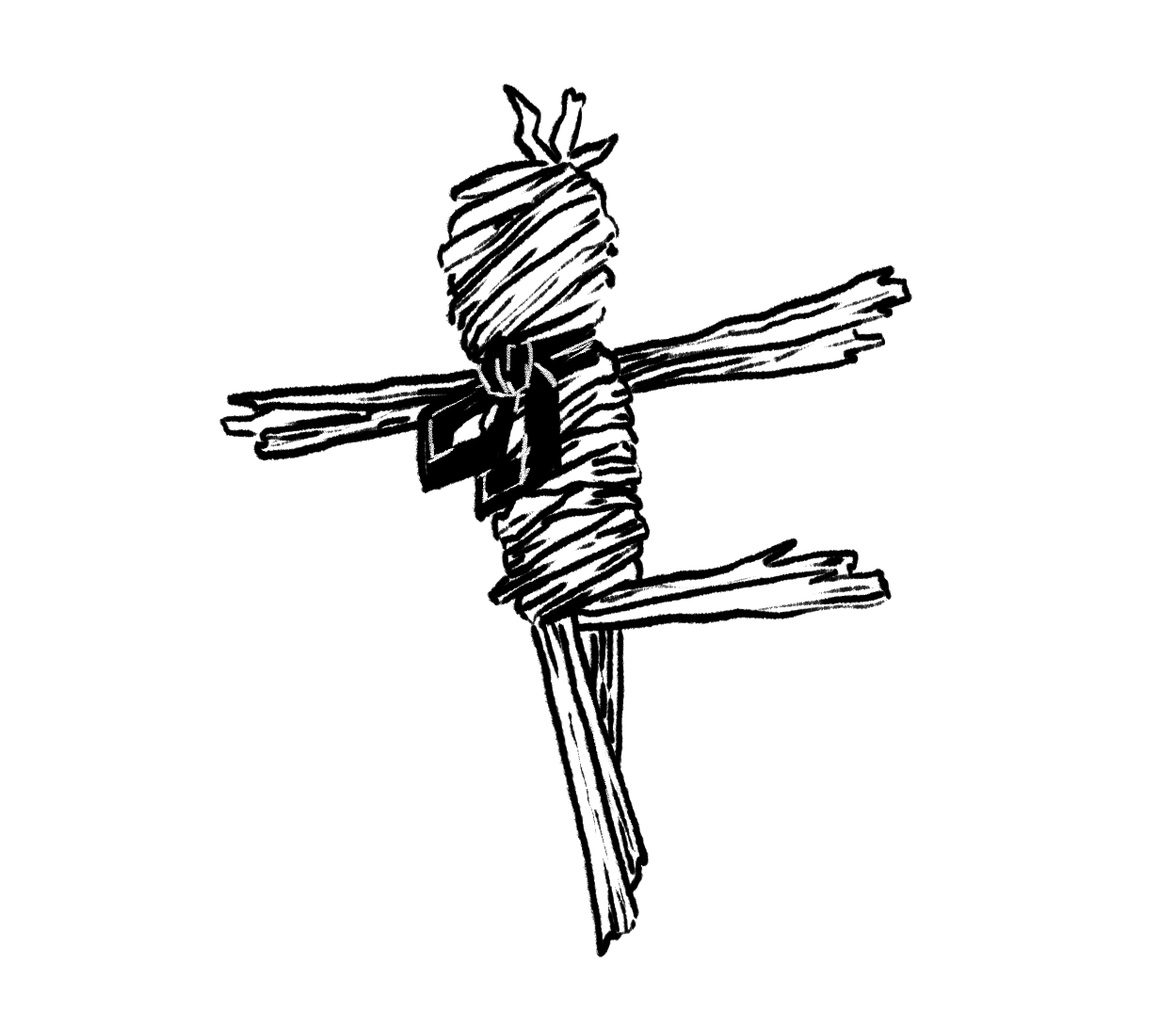
At the top of the fly tower, Sophie unties the charm that hangs on the grid high above the proscenium. It is a small man made of wood and wicker, the most flammable thing in this theater that’s not a cigarette.
“Bring it back by dawn,” Sophie tells me. “Otherwise, none of us are safe. Don’t let your love be the last story this theater tells.”
I give Sophie one last kiss, arm myself from the props table, and leave the theater. Outside, the small wicker man jumps out of my hands and starts down the street, recklessly running into raindrops while I chase after it with an umbrella. I’m still half in costume, my face obscured by a thick gingery fake beard. When I buy a train ticket, the attendant calls me “sir” and it terrifies me until I remember I have the charm with me—it’s standing on my shoe, in fact—and I am safe.
We ride the train for twelve stops, until the wicker charm gets off. This neighborhood is rich, respectable, and frankly, enemy territory. The wicker charm looks over its shoulder with palpable impatience at my sudden reluctance. My knight bested dragons for me. The least I can do is stare down some stock brokers. I build my nerve and follow.
The house that the charm leads me to is all lit up, guests in evening gowns and black ties laughing in the windows. Sir Castle is there, a man’s arm around her waist. She’s holding a martini glass so tightly that her knuckles are white.
I’ve never seen her look so small before. There ought to be violence in her aspect, and a weapon in her hand.
I go to the window and knock. Sir Castle puts down her drink and opens it for me. The rest of the people at the party see a bearded man in a rumpled coat holding an umbrella in one hand and a prop sword in the other.
I see my knight. I see her in plaster armor painted gold, stage lights haloing her hair as she places a crown of paste jewels on my head.
I hand her the sword.
© 2026 M. S. Dean
M.S. Dean is a queer Muslim writer living in New Jersey. She is a former theater kid and has a PhD in biology, which she mainly uses to read and write about eyeballs. Find out more at msdean.carrd.co.