He picked me up at my hotel, looking more or less like his pictures, when I’d finally coaxed them out of him. I’d had to prove I was who I said I was, which is to say: not from here. Not a threat. It was the same way with me the first time. Strangers are safer when you’ve got a secret to keep.
He was handsome enough, this man, though that wasn’t the point, and anyways, the ugly ones eat the best ass. In the messages he’d spelled discreet correctly and said he worked right around the corner, in advertising. Plus the dick was magnificent. More than enough to get me showered, shoes on, sliding now into his passenger seat.
I asked, “How long do we have for your lunch?”
He told me he wasn’t on lunch.
I said I thought he was at work, right around the corner.
He said he was off all week.
I said I’d misunderstood but he didn’t seem interested in explaining so I let it go. I turned to other subjects. When I’d asked too many questions about work, life in Ankara, what it was like being gay here, he cut me off. He wasn’t rude but firm, his accent vaguely British, suggesting boarding school, maybe, or time abroad. He wasn’t gay. “Men are just easier,” he said, turning up the Lady Gaga.
While homosexuality wasn’t illegal here, it also wasn’t easy. Grindr, for instance, was banned. There are workarounds and if you know, you know. One trick is Hornet. Another involves a VPN. You set your Grindr location to this one tiny town in Western Africa and then all the men meet there online. I like to think about that town, disproportionately and digitally populated with a statistically unlikely quantity of handsome, hungry torsos, all going to Africa to meet the man next door. In my head, the virtual world is featureless, a sheen of black glass, a non-space where even echoes die . But then there’s this one beacon. A town glowing green with activity, so green and so bright on some server, you could see it from space.
He drove us further than I expected—north, if I was tracking correctly—way out past this enormous city. When I asked where we were going, he assured me he knew a spot, which wasn’t what I asked. I hadn’t thought to take a photo of his license plate. I hadn’t thought to take a photo or send that photo of a license plate to a friend since the first time, with an older guy passing through “for business,” he said, the night I got a taste for this in the outskirts of Windsor, Ontario.
The bank buildings became apartment buildings, became industrial buildings, became new builds and then old builds, abandoned. Became dirt, rock, and dust. I lost cell service around the time I started seeing pine trees. It would be hard to get back if he tried to rob and leave me out here.
Eventually we turned off down a long, bumpy road, coming to a stop beside a tall pile of rebar and some brush. He dialed down the music but kept the car running—for the A/C, I hoped, rather than a quick getaway.
I’d made sure to leave my valuables and passport in the room, taking only some cash and my phone—just enough cash that if this was a long drive to a short shakedown, it would be worth his while. You want to make it worth their while. But there was no extortion,, no weapons, no friends to jump us at the end of the drive. In fact, the further we got, the more relaxed he seemed. His shoulders untensed. By the time we stopped, he finally let himself look at me. And now he was smiling.
“You are very handsome,” he said, which lately I’d let myself believe. I’d come a long way since Windsor, since owning my desire, since the many men since then, in hearing the same thing from all of them I’d started to believe it myself. It’s not that the things you want can make you beautiful, but they need not make you ugly. Or a monster.
“Should we?” I said, pulling the handle to get out.
“No,” he said, alarmed. I let get of the door, raised my hands. He surprised both of us, it seemed, with how loud and sudden the answer came. “Someone might see us.” He was sheepish again, embarrassed to look at me.
“Oh.”
“It’s too dangerous.”
I scanned the distance, trying to imagine someone lying belly down in the brush behind binoculars. He didn’t say what to do next so I undid my belt. “Here, then,” I said “no problem.” His jaw loosened. I shook off my sandals. He put one hand down the front of his pants and started working himself. I liked his quick brown eyes. “May I suck you?” he asked.
It’s hard to be elegant unpantsing oneself in a car. I leaned back into the seat and lifted my hips, had my forehead almost against the ceiling, and got my jeans around my ankles and my underwear too, all in one fell swoop.
“No no,” he said, eyes wide again, “not all the way off! If the cops come we might need to pull them on quickly.” He looked up and down the road as though he might have summoned the threat into existence.
I got my pants back up and looked at him for direction. “Just one more thing,” he said. “One more minute, okay?”
With the trunk open, I couldn’t see what he was doing in the rearview mirror. Eventually he came back around the side, dropping a bag by the driver’s side door.
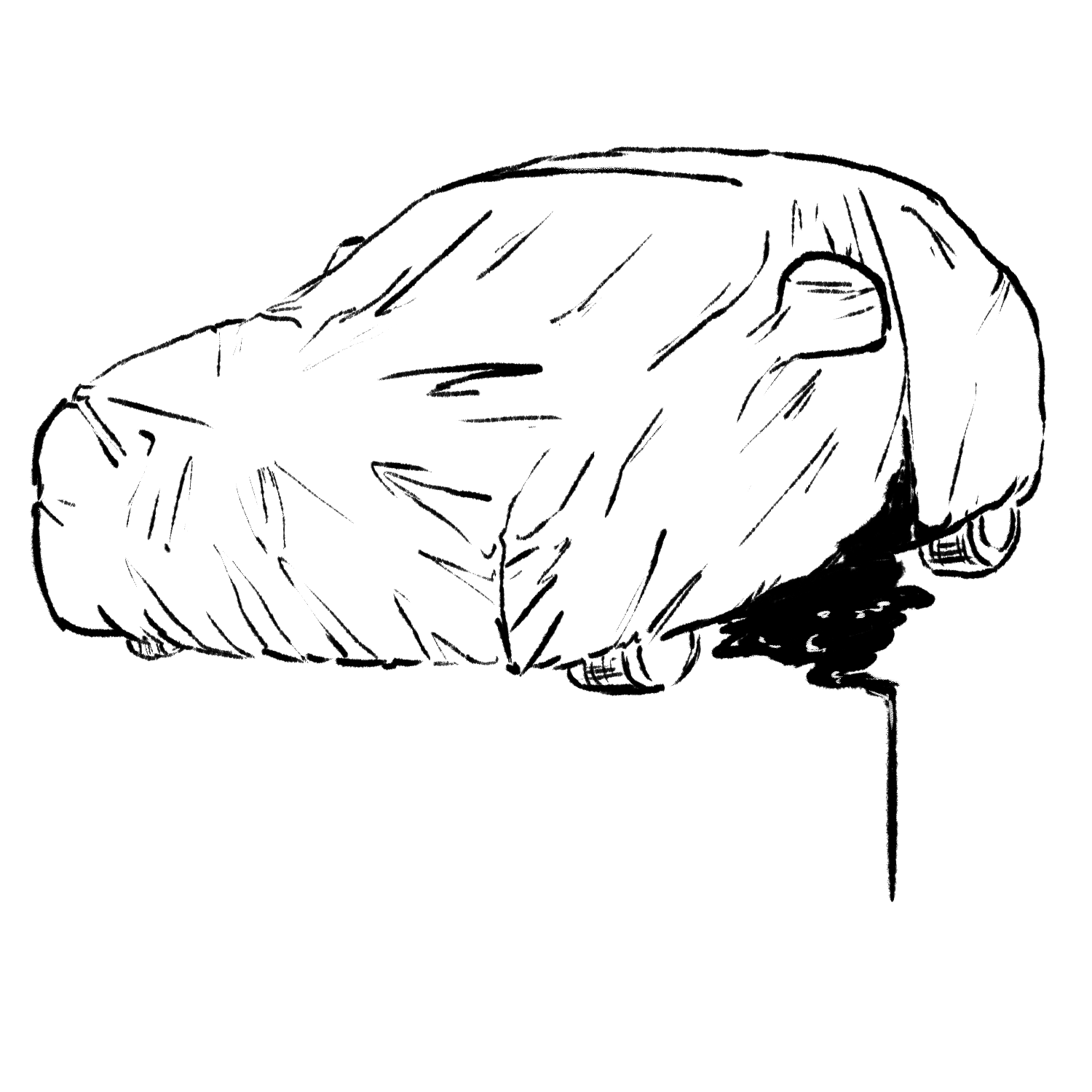
He was very quick to set it up. It was all very professional. Smiling the whole time and nodding to reassure me, he covered the entire vehicle in the kind of car tent you might take camping. It was darker under the tent and cool, the dry world outside looking drier through sepia toned plastic of the flaps he dropped down. And in his rush to get it all set up, I noticed, he’d left the keys inside, sweet thing, sweet careless thing. I almost felt bad for him. All that paranoia to keep himself safe from the outside world, having no idea where the real danger was.
I don’t bite. It’s not like the movies. But I can imagine how it might look like that to someone outside. With your binoculars in the field, you’d see me holding him tight, mouth so close to his ear, one hand in the hair up the back of his head. Maybe, if you crept up on us, you’d even see the catch of his breath, the fear and the excitement in his eyes, and then the softening, the laxity, the thing that means it’s over.
I said what was said to me and did as I was taught.
A few days, a week, a month at most and I’ll be gone. But he’ll be here. And all the others too. I don’t like the word turned. I prefer opened. We have opened a world to him. And I don’t need to stick around to know it worked. The signs will be there, if you know to look for them. A glowing green map and a world apart, for those like us, who could make each other beautiful.
© 2026 Brendan Bowles
Brendan Bowles is a writer from Toronto, Ontario. His work has been published and produced for stage and radio and has appeared most recently in The Adroit Journal. He’s currently an Assistant Professor of Creative Writing at Stetson University in Florida.