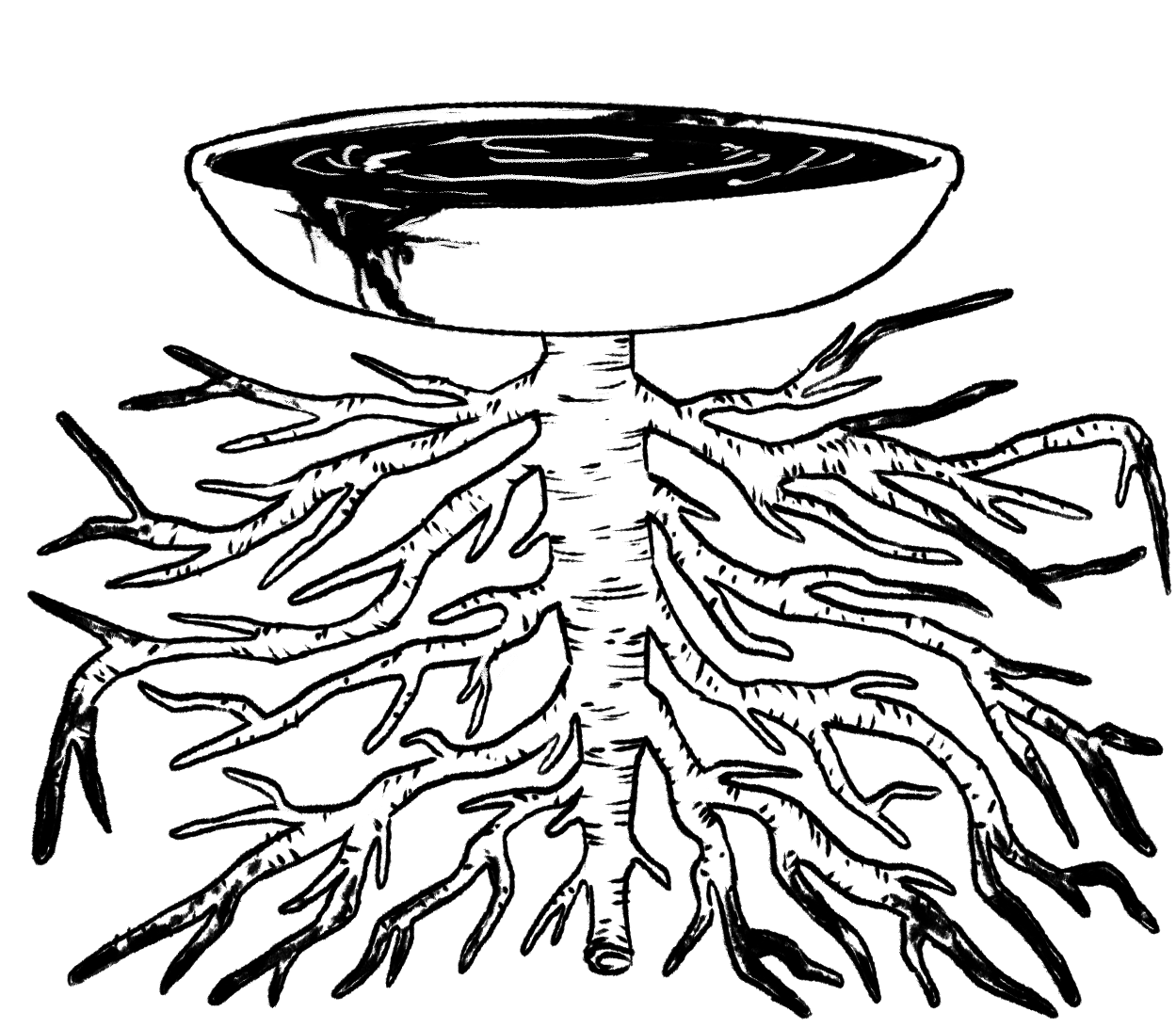
Bruising is a blessing. A body must bruise to prove it can hold more than the blood required for survival. Press a wound to root and it purples. The land drinks what your skin remembers and returns its memories to the mountain.
You have been bruised too many times—on your shoulder where a falling roof tile struck, a third time on the soft hollow above your heart where you pressed a root too hard in prayer to Sēluneh. But the night you were Marked in Zafēle Valley, the elders wrapped your wrists in river-reed and pressed your palm to the nearest root, which was cold and wet, as if it had just wept. The elder’s chants pinned you there by the riverbed. The root, waving in the open air like soft white eels, trembled against the inside of your thighs and turned a dull crimson where your violet-mottled fingers rested. The elders sung the pale lengths, now reddened with the ache of your first bleeding.
Too much bruising thins the blood; Sēluneh will turn her face away from a cracked vessel.
†
Long ago, the moon Sēluneh had a twin who circled the night beside her—Daremah— whose face blushed deep as ripened sorrel. Sēluneh, alabaster-skinned, envied her sister’s glow. Vain for that shade, she demanded the earth’s daughters bleed each month so she could drink their color, staining her cheeks with their hue. In exchange, she promised the rivers and wells would never run dry.
But one girl—her name lost, her bones ground into dust—refused. The river shrank to a silver thread. The villagers barred the girl from the wells, forbade her from drinking the dwindling rations, and burned her bedding at the crossroads. When she was gone, driven past the valley’s edge, rain returned.
Ever since, when a girl taints her sacrificial blood to Sēluneh with unclean thoughts, the roots flare gold, fouling the water until the next communal bleeding is due. This is the law of the Moon-Tithe.
†
“Now that you are Marked, you will gather at the river each season on the third day of your cycle, when the blood runs darkest. Our scarlet tides begin and end together, drawn by Sēluneh’s pull,” the elder said, writing on the ledger, names inked in columns, moon-marks tallied like coins owed. She turned the book so you could see yours in fresh ink, and just above it, Marua’s.
†
When you return home from the elders, you think of your father mending nets by lantern-light, the smell of tar sealing his boat’s seams, the worry that if the river turns to salt, the nets will stiffen and tear. He would look at you as if your body’s failure were the knife that cut his livelihood loose.
By Sēluneh’s third pale pallor, your father had accepted Daveedem’s marriage proposal, who examines you the way men appraise nets: checking how much strain you can withstand before splitting. At the betrothal meal, his palm swallowed your wrist whole. He pressed his thumb where your pulse thrashed and held it there, counting.
In two moons, Marua will marry the boat-builder from the northern marsh—young, loud, with all his teeth and a laugh that carries—while Daveedem will take you to his smoke-stained house where two wives’ ghosts already curl in the corners.
†
Glass-finned fish break the surface, catch Daremha’s crimson glint, and sink again. Marua kneels three bodies away. Moonlight silvers the curve of her neck where it meets her shoulder, charting forbidden coastlines. At her nape, a coily hair escapes its braid in damp tendrils, where your lips dream of making that same journey. Her obsidian skin catches the moon differently than yours; where you bruise purple, she bruises midnight plum. You have catalogued her through a hundred gatherings: the tendons rising in her wrists as she tilts her bowl, the blue vein that pulses at her inner elbow, the small ivory scar near her thumb given by the harvest knife. You have practiced speaking her name in the dark until the syllables lose architecture and become only breath, only ache.
Marua’s bowl is already half-full; the dark fluid trembles, glistening. When she finally glances your way, her expression holds mild concern, the look you’d give a cracked bowl, any broken thing.
Marua whispers across the water, “If you don’t pour tonight, the roots will record your disobedience and carry it under the soil all the way to the mountain that keeps every root’s whisper and never forgives.”
You walk to the circle and kneel. The reed mat squelches with river-muck. You lower your filled bowl and shape ritual prayer on your tongue as if you mean it, but the root beneath your knees recoils; violent shudders travel up your thighs. A golden bruise the width of a hair-strand blooms outward, spreading like spilled oil, veining through the root’s tallow flesh in tributaries. It throbs in rhythm with your racing heart. You tighten your grip on the bowl. What if it stains the water? You imagine the elders finding it, tracing the corruption back to you. You have heard what becomes of Marked women whose offerings are refused. You press your knees harder unto the ground, willing the root to still. No one must see. No one! Then the saffron light thins from sight.
†
Next moon at the circle, you are sure Marua had finally seen you admiring her. You imagine her gaze catching the glimmer, her voice rising in warning, the village turning toward you in one slow collective motion.
Your fingers sweat on the bowl. It tips—a fraction too far. You snatch it back too late, a precious spill sliding to the earth. At the brush of your lashes, auric light flares, then dulls to a sullen ochre stain, then grey, and slips beneath the waterline where the roots drink deepest. The elders continue their prayers, oblivious; no one else sees. Under the soil, the roots whisper your treason to each other, passing it toward the mountain.
Your pulse keeps hammering, accusing you of deception, as you lower the bowl into the river. When the moon rises—green-edged, swollen—its light turns the river iron-colored. The Marked sing a litany of names, of all the bleeding virgins who ever faltered. All around, bruises meet bark—memory slips from the girls’ bodies and returns bearing the mountain’s judgement.
You press your bruised shoulder to a wet root. It bruises back, purple blooming along its pale flesh, and in that shared stain, you feel an opening. For a breath, you glimpse the first girl, the one who refused, standing knee-deep in a cracked riverbed whose mud has dried into plates sharp as broken pottery. Her ankles are ringed with dust. She holds a clay bowl tight to her chest. Her shadow stretches forked and black; her lips press together. The look she gives you is not blame but a tired, salt-bitten mirth that makes your throat ache. You blink; she is gone.
Above the Zafēle Valley, Sēluneh edges closer, dawn blooming across her cheeks. Empty bowls glimmer where the tide has passed; roots sag under the weight of new memories, and you linger as the Marked, wrists banded in reed, drift home in silence.
The river’s cool breath seeps into your bones, knees buried in silt. Tiny shrimp scuttle from beneath stones; heron-shadow glides overhead. You study the purple bloom on the root and wonder if the mountain will carry word of the spilled offering.
You should wish it had never happened. You hadn’t meant for the blood to spoil the river.
Or perhaps, some part of you did.
© 2026 Aishatu Ado
Aishatu Ado (she/her) is an Afro-German folklore ecologist obsessed with a question empire prefers unanswered: what does a story do when it refuses to stay dead? Drawing on African and diasporic cosmovisions, she traces how oral traditions survive rupture and seed liberated futures. Her collection, Black Box Flight Recorder, won the 2025 Button Poetry Chapbook Contest. She has also won Fractured Lit’s Ghosts, Fables, Fairy Tales Prize and the Jerry Jazz Musician Short Fiction Contest. A Clarion West graduate, she has received fellowships from Tin House, The Kenyon Review, Hurston/Wright, VONA, Roots Wounds Words, and Voodoonauts. Aishatu’s work has been published in Nightmare, FIYAH, CRAFT, Baffling, Heartlines Spec, Kelp’s Ocean Poetry Anthology, Augur, and Flame Tree’s Afrofuturism Short Stories and Dreams Divine. More at aishatu.carrd.co.